

For a long time, the world has leaned heavily on a fix-it model of healing. Trauma, anxiety, and addiction have long been framed as problems to medicate away. If something hurt, the goal was to numb it, suppress it, or disconnect from it, but we know by now that this approach often doesn’t help in the long run.
Thankfully, something is changing.
A more profound wisdom is slowly flowing back into the collective, and people are starting to realise that healing is less about fighting parts of yourself and more about integrating them.
Although professional care is sometimes necessary, certain practices can offer an alternative avenue for addressing some of your issues by getting to the root of them.
While some people turn to plant medicines like Magic Mushrooms or Ayahuasca as powerful tools to access the unconscious mind, they’re certainly not for everyone. Some people aren’t drawn to ceremonial work; many don’t have access to it; and others can’t participate due to medication or health restrictions.
Holotropic Breathwork is different because it’s generally compatible with antidepressants and most other medications, which makes the entry point a lot more open for people who want deep inner work without the adverse risks.
But there’s an alternative!
If you’ve been asking yourself, what is Holotropic Breathwork, and how to do it in a way that takes you into those deeper layers of consciousness without a crutch, this guide will walk you through everything you need to know.
What is Holotropic Breathwork?
Breathwork has boomed in recent years, and everyone wants to try it out for themselves. But there are many different kinds.
It can be a philosophy, a technique, a meditative practice, or even an exercise to help you sleep.
The breath is very versatile, and every technique offers a unique angle for working with it.
For example, Pranayama is a form of breathwork, as are Box breathing, Rebirthing Breathwork, and many others.
That brings us to Holotropic Breathwork, an experiential method of self-exploration characterised by accelerated breathing, evocative music, and a special bodywork that helps to release residual bioenergetic and emotional blocks.
A session generally lasts 3 hours, inducing an expanded state of consciousness to:
- Facilitate deep emotional healing.
- Clear stagnant energies or blockages.
- Aid self-exploration and self-discovery.
Essentially, it’s a guided practice of using your breath to create a doorway into the unconscious where unresolved trauma and dense energies often stagnate and manifest.
It’s based on the idea of your innate inner healing intelligence, which considers that you are the source of your own healing. The unconscious, the body, and the spirit each contain an inner wisdom that you can tap into with the right practice.
This is why it’s not just a way to enter the unconscious, but also a way to raise your consciousness so you can understand yourself more deeply.
Where did Holotropic Breathwork come from?
Holotropic Breathwork isn’t an ancient practice like some you might find within Yogic traditions. It’s a relatively new adaptation that carries a different intention.
It was developed in 1975 at the Esalen Institute (United States) and rose as an alternative pathway for experiencing expanded states of consciousness.
Stanislav Grof, the founder of this technique, was a leading researcher working with LSD in therapeutic settings. When the government cracked down on psychedelics, together with his wife, Christina, he began experimenting with intensified breathing and evocative music.
They noticed that via this technique, people were entering similar states to those induced through psychedelics.
As the method evolved, the Grofs developed a clear structure and began teaching it to others.
At first, it was mostly psychonauts who jumped on board, and it built a reputation in the “conscious community” for the undeniably powerful experiences it induces.
As awareness grew, Holotropic Breathwork retreats, workshops, and facilitator trainings quickly spread across the US and Europe, eventually becoming a well-recognised modality in the healing world.
What does Holotropic Breathwork do?
Unprocessed material lives in the unconscious. Everything you avoided, suppressed, or weren’t ready to face tends to settle there, potentially manifesting dysfunction mentally, emotionally, and even physically.
You don’t simply outgrow trauma; you store it until it’s ready to be addressed.
So, when you see the conscious mind as a reflection of the unconscious, you also see why it’s necessary to venture into this hidden territory at times to release some of the residue that has been trapped in there.
Holotropic Breathwork affects different layers of your being, including:
- Physiologically. Changes the balance of oxygen and carbon dioxide in the bloodstream and changes how the brain processes sensory information. The nervous system becomes more activated, and the thinking mind loses its hold.
- Psychologically. Emotions that were buried begin to rise into the conscious mind so they can be explored and expressed. It creates a channel to access some of these deep-rooted traumas so they can be processed consciously.
- Energetically. Energies constantly move through our bodies, and they can get stuck. Breathwork acts like a cleansing wave, moving energy to stagnant areas and helping clear blockages.
So, it doesn’t just work on your mind; it cleanses the energetic body, too. This is usually why you feel great after a session, and many people feel like they’ve been reset.

Opening up the inner world via HB
The fantastic thing about this technique is that it facilitates an inward journey. This gives you the time and space to work through a range of feelings, thoughts, worries, and limiting beliefs.
To create a doorway into this expanded state of consciousness, there are three main parts:
- Breath.
- Music.
- Bodywork.
Holotropic Breathwork usually involves breathing through the mouth or nose while listening to carefully curated music and facilitating energy release through a specific form of bodywork. These three elements work well together and, when combined with intention, create the conditions for deep inner work.
In this sense, the breath acts like a key, allowing the body’s inner intelligence to bring what’s been buried into awareness, but the work happens when that information is processed (and then integrated).
The music follows the session’s curve, usually a playlist spanning multiple genres, featuring tribal rhythms, emotional soundscapes, and more mystical ambient tracks, each with its own tone and guiding you into different inner terrain.
This work is really based on the therapeutic potential of expanded states of consciousness. This healing power of expanded states has been used by ancient cultures for millennia in their healing practices.
It’s not a means to escape reality or a natural way to “get high”. Yes, experiencing expanded states of consciousness is part of the journey, but it’s meant to loosen the grip of the conscious mind so the real work can be done.
Holotropic Breathwork benefits
The benefits can be subtle or profound. With that said, everyone responds differently because everyone’s inner healing intelligence follows a unique journey!
Some sessions can feel deeply cathartic and emotionally cleansing, while others might be more insightful or expansive.
Because the technique works on different levels, people tend to experience a wide range of effects, including:
- Enhanced mood and well-being.
- Gaining deep insights or realisations.
- Feeling lighter and more open afterwards.
- Deep emotional catharsis and the release of dense energies.
- Providing a sense of inner spaciousness and emotional relief.
- Stress reduction.
- Increased self-awareness.
- Feeling mentally clearer and more focused.
- Release of stored tension in the body.
- Vivid or symbolic inner experiences.
- A greater sense of peace or integration.
- Experiencing visions and extrasensory phenomena.
While these are some common benefits people experience, this practice can also have physical health benefits, including boosted immune function, reduced psychosomatic pain and migraines, and improved blood circulation.
Some people describe the post-session feeling as a sense of relief. Others say it feels like they’ve finally let go of something they’ve been carrying for years.
Mostly, your healing depends on what’s most readily available for processing in your unconscious and in your own inner healing intelligence.
How deeply you go into your processes also plays a significant role. The more you give, the more you receive.
Is Holotropic Breathing dangerous?
While this technique has many great benefits, it must still be approached with caution. It’s an intense process that can shock your body and cause some unpleasant sensations.
People commonly experience symptoms such as tetany, lightheadedness, muscle contractions, disorientation, or overwhelming emotions. While none of this is necessarily dangerous, some precautions must be taken, especially for certain conditions.
But is it dangerous?
Generally, no, but that doesn’t mean it’s suitable for everyone!
When people don’t have the inner resources or support network to deal with what arises, it’s possible to slide into feelings of anxiety or emotional overwhelm.
As a rule of thumb, avoid Holotropic Breathwork if you have any of the following conditions:
- Severe mental health conditions such as schizophrenia, psychosis, or bipolar disorder.
- Cardiovascular conditions, including heart attacks or cardiovascular surgery.
- High blood pressure.
- Epilepsy.
- Pregnancy.
- Recent surgeries.
- Glaucoma.
- Retinal detachment.
- Osteoporosis.
- Asthma–depending on the case. If you have asthma, please bring an inhaler to the workshop.
Working with a trained facilitator creates a safe container, almost acting like safety rails. They can keep you within a safe range while you’re working with this technique, and lead you through the process.
How to do Holotropic Breathwork?
While you might feel tempted to skip the theory and try it by yourself, do not practice on your own! Not even experienced facilitators with decades of experience practice it alone.
It can be dangerous to practice without a certified instructor, as their role is to:
- Keep you on track, make you stay focused, and observe your technique. Without one, it can be challenging to reach those deeper states, as your psyche can’t fully relax.
- Help you navigate the experience when strong emotions or physical reactions surface, and stay safe.
- Facilitate specialised bodywork to help release residual bioenergetic and emotional blocks.
This is why it is always done in workshops or one-on-one sessions with a trained facilitator. The container is essential to the safety, depth, and clarity of the experience.
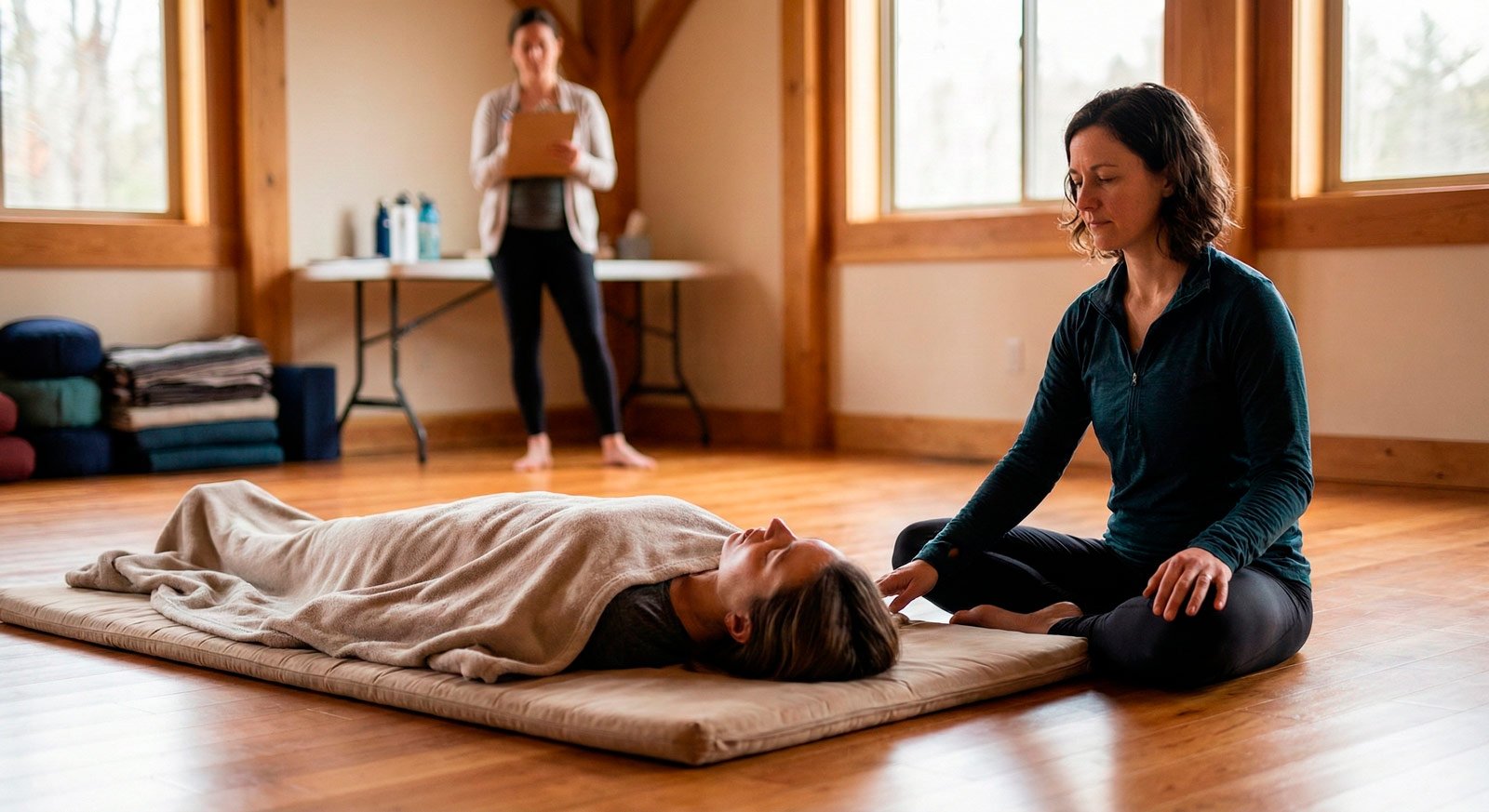
The sessions are usually conducted in groups, with participants working in pairs and alternating between the roles of breathers and sitters. The process is supervised by trained facilitators, who assist participants whenever special intervention is necessary.
“Accessing the deeper levels of the unconscious holds immense healing potential when experienced in the right setting.” — Stanislav Grof, The Holotropic Mind
A typical Holotropic Breathwork workshop is a one-day event that includes:
- A theoretical introduction that explains the psychology, the theoretical framework, and the process.
- A full breathing session with a certified facilitator and a sitter supporting you.
- Time spent as a sitter supporting another participant in their breathing session.
- A guided integration circle consisting of a Mandala drawing and group processing.
- An online follow-up integration session to help you process what surfaced during your day-to-day life.
So, if you’re wondering how to try this practice, seek out a workshop that offers the full support and guidance essential for your safety.
Holotropic Breathwork with Avalon
Holotropic breathwork is not something you want to try alone. The experience goes deep, and the person holding the space matters as much as the practice itself.
This is why we’ve decided to offer our own one-day Holotropic Breathwork workshops to support all the other powerful medicine work that happens here and to provide a container for anyone who wants to explore this practice in a professional environment.
At Avalon, every session is led by certified facilitators who can safely guide and support you through whatever comes up. They are trained and experienced, and you can rest assured that you’re in good hands.
Alternatively, if you prefer to experience it alongside ancestral medicines such as Ayahuasca or San Pedro, we also offer a dedicated session as part of our 6-day retreats.
When the space is held well, this practice can take you into places within yourself that you may not have visited before. It’s powerful and, for many people, a turning point on their healing path, without the commitment required to work with ancestral medicines.
If you want to explore this work, check out our upcoming Holotropic Breathwork events, either as an isolated workshop or as part of a retreat, or book a call with us, and we’ll be happy to have a chat and see if this is a good move for you.