
What is medicine music?
Think of it as the soundscape of a ceremony. Most people associate the term with the music sung within plant medicine ceremonies, especially within the context of South American healing traditions.
First off, in these traditions, medicine isn’t just a substance like Ayahuasca or San Pedro.
Medicine can be anything that brings healing and transformation.
Plants can be medicine, rituals can be medicine, prayer can be medicine, and music can also be medicine, especially if it’s used in a way that’s conducive to healing.
With that said, the term is more of a modern label that grew out of people trying to describe this sort of music that has evolved alongside the ceremony space.
Over time, this label became an umbrella term, describing a more intimate connection with music for healing. So, it doesn’t just include one genre, although the term is mostly associated with Latin American music used within plant medicine ceremonies.
How to recognise it
In many traditions, what we call music isn’t really seen as just something we listen to. It’s recognised more so as a tool that supports a person’s internal processes. Calling it “music” is more of a Western way of framing something that’s much more functional in practice.
For example, singing mantras can be deeply healing, but most people wouldn’t consider it to be medicine music. Rao bewá (commonly known as ícaros), sung by the Shipibo healers from the Peruvian Amazon, is another interesting case.
Ícaros or ikaros are undeniably healing and play a massive role within their healing traditions. Still, most people wouldn’t slot them under the same label, as traditionally, it’s not considered music; it’s more of a tool to facilitate what is often called “energetic surgery.”
Academic research into the Shipibo tradition documents how these songs are believed to be received directly from plant spirits during apprenticeship. Not composed, but transmitted.
So, there are some grey lines here…
It’s less about the genre and more about the intention behind it.
It’s music that’s used to shift your state. That could mean helping you relax, process emotions, go deeper in meditation, or connect with something beyond your usual thinking mind.
It is often inspired by shamanic practices, in which sound has long been used as a tool for healing and guidance.
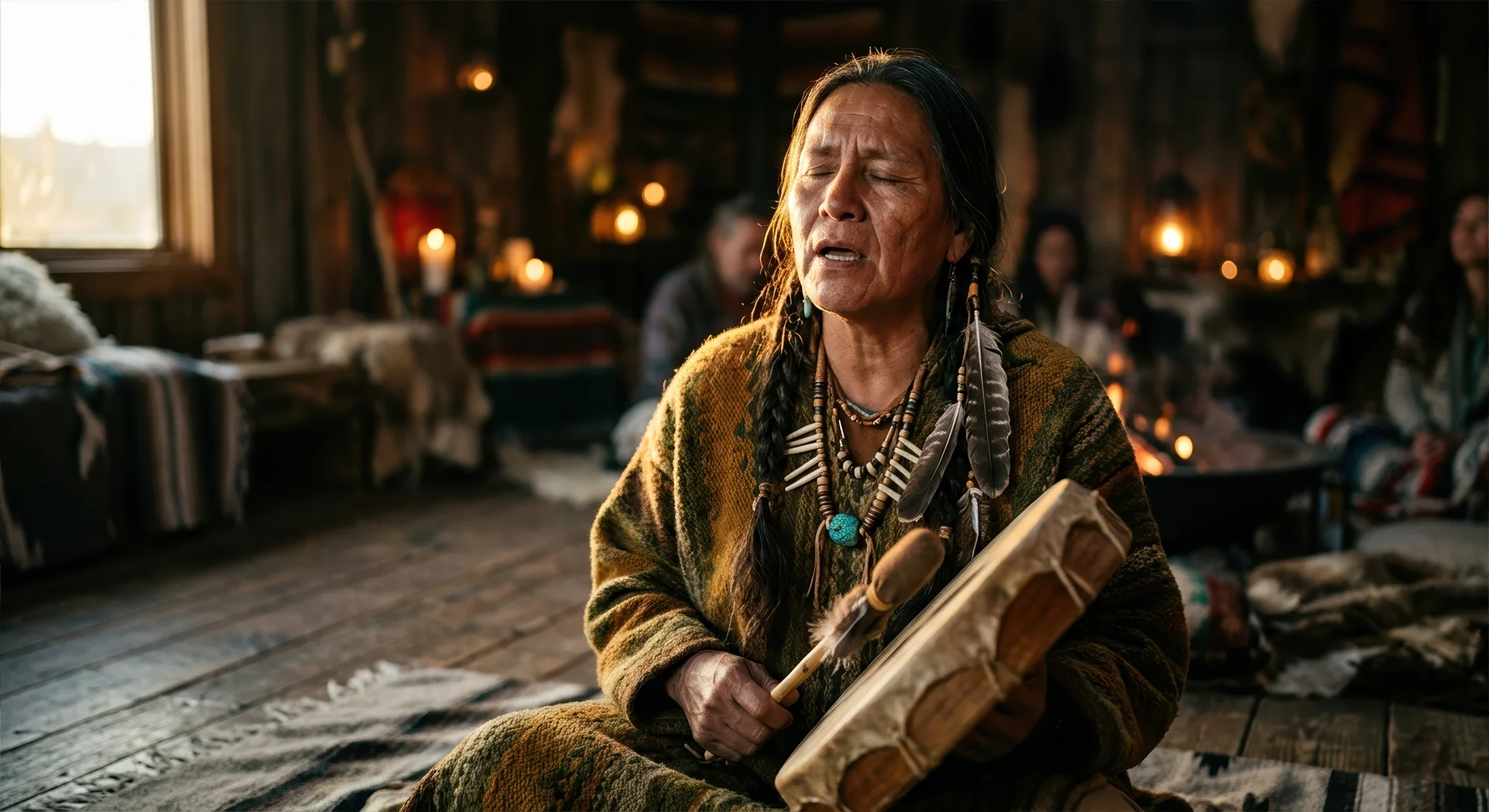
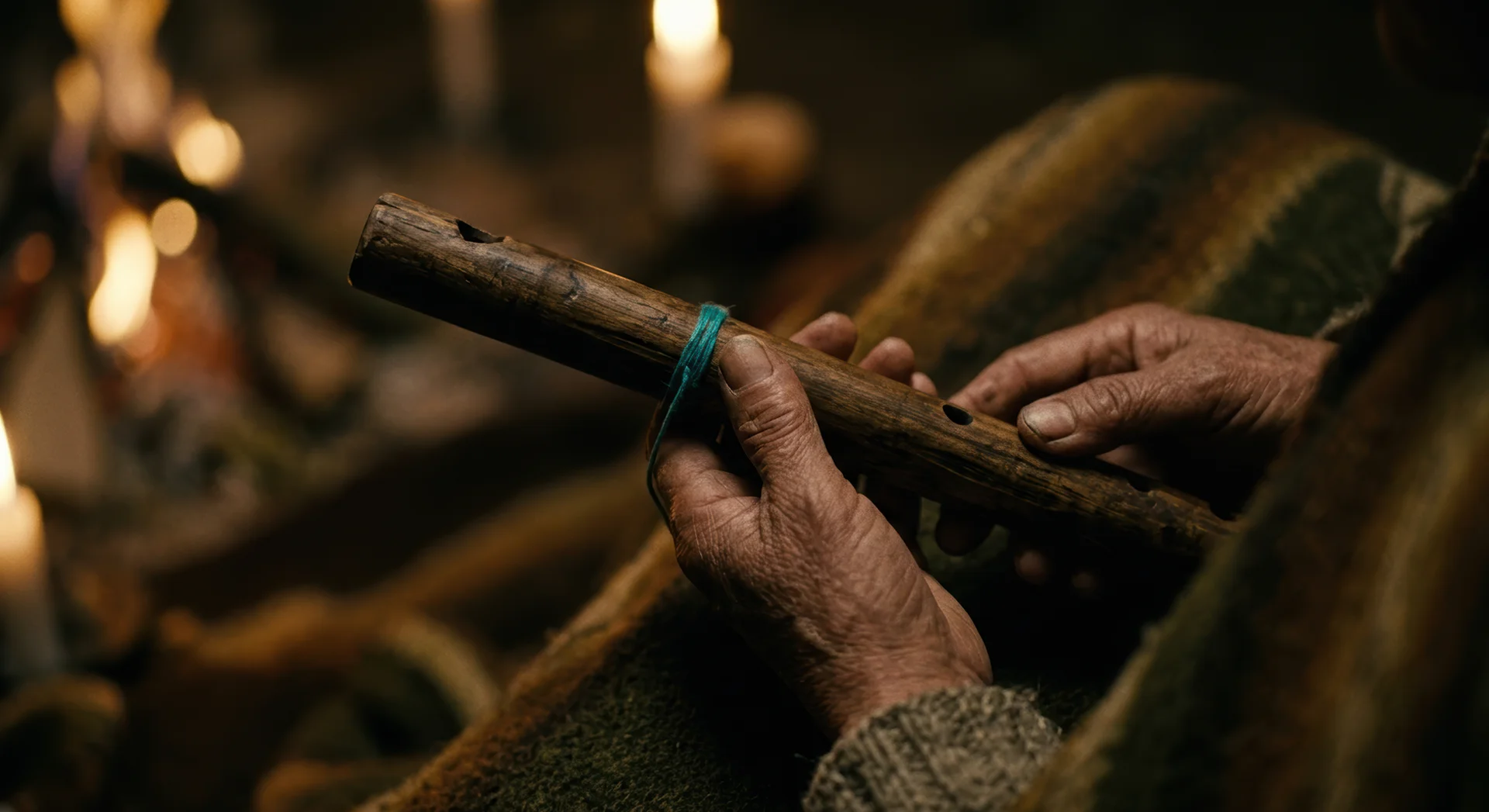
Drums, voice, flutes, rattles… The common culprits of this type of music. These aren’t just used to make pretty sounds. They’re ways of moving energy and holding a container.
Because of this, medicine music tends to have some signature characteristics:
- Rhythmic. It often builds around steady and repetitive patterns.
- Simple. It’s usually not overly layered or complex, which makes it easier to drop in and get carried away.
- Voice-led. The voice is central, and it’s often supported with instruments like rattles, drums, flutes, and guitars.
- Intentional. The music is created and sung with a clear purpose. It’s not just for background listening.
You can usually feel the difference, too.
Some music is just there in the background. Sure, it can be beautiful, it can be calming. But medicine music has a way of pulling you in.
It’s there to guide the experience, move energy throughout the space, and in some traditions, even support the work of healing spirits throughout the ceremony.
What makes music “medicine”?
From what I’ve been taught while studying ancestral medicine traditions in South America, music becomes medicine when it carries a healing frequency, which is transferred when it’s sung from a space of love, gratitude, and presence.
The role is to:
- Hold the space. It creates a container so the experience doesn’t feel too overwhelming, and you don’t get lost in the journey.
- Ground the participants. It helps bring you back into your body when things get intense, acting like a tether between the material and the astral.
- Move energy. It helps energy move through the body and release rather than get stuck. It can also assist the process of purging, especially when people feel blocked or have some sort of internal friction.
- Purify the space. It helps clear dense or stagnant energies and supports the ceremony’s overall process.
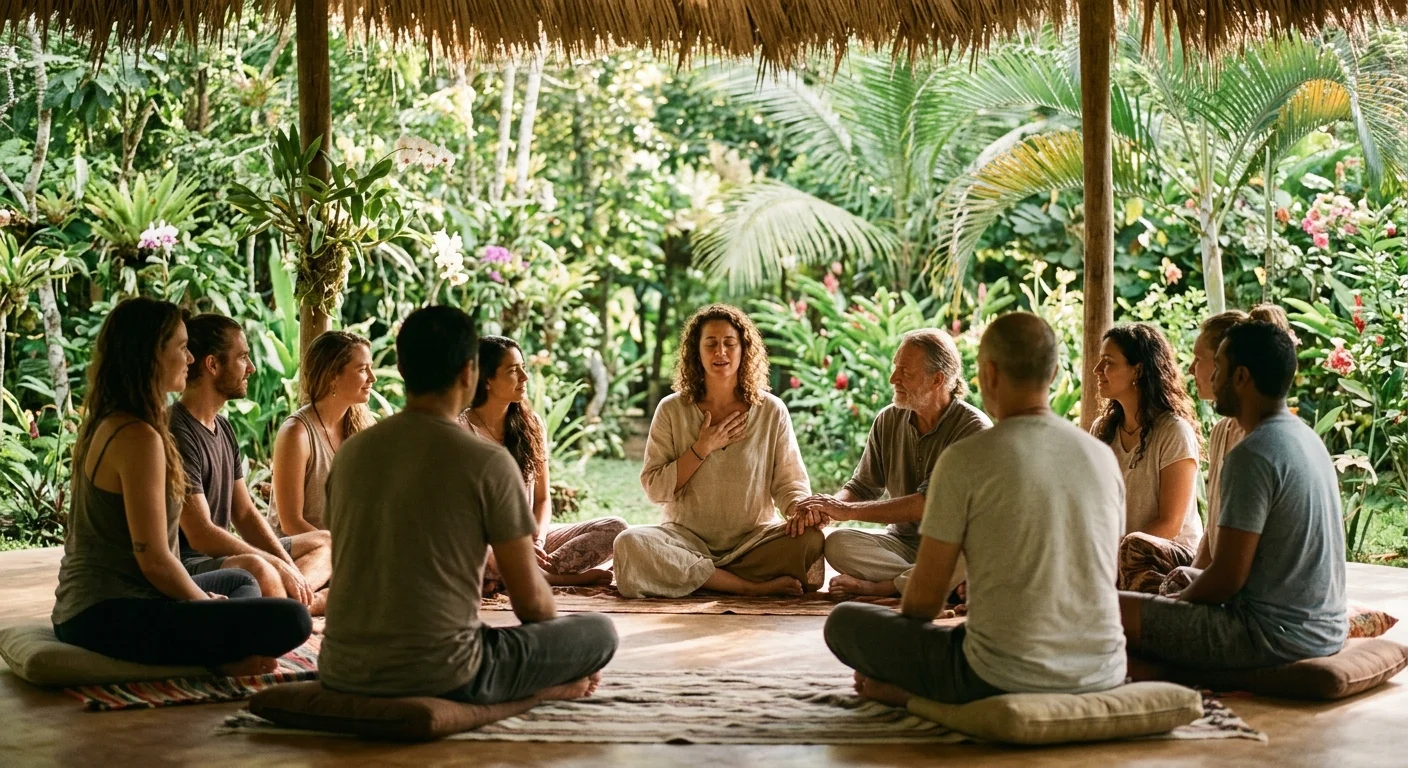
- Creates a shared field. It brings everyone into the same energetic space, so the group moves harmoniously as a whole rather than being scattered and disconnected.
Another core role is to raise the energy of the space.
You don’t need to be in a ceremony to experience this. You probably have many times before, because music carries a vibration!
Sometimes a song touches you so deeply that you almost feel like crying, or some powerful emotions rise to the surface. Sometimes, a spectacular performance will give you goosebumps, or a beautiful song will shift your state of mind almost instantaneously.
Some sort of alchemy is happening here, and you feel it viscerally, emotionally, and spiritually, even if you can’t explain it. That’s because music is a vehicle, and like any vehicle, what matters just as much as the vessel itself is what it’s carrying.
A systematic review of 50 neuroscience studies found that music directly engages the brain regions responsible for emotional processing and regulation, meaning what you feel during a powerful song is physiologically real.
Music is a vehicle
Music is a powerful avenue to support the process of healing. And for the music to actually shift the space, it has to come from a real place. There is no faking it because that vibration is a reflection rippling outwards, a mirror of the state of consciousness of the singer.
Therefore, the words themselves aren’t all that important. The melody doesn’t need to be perfect. When someone is singing as a true expression of their soul rather than just trying to sound good, it hits differently. You feel it viscerally, as if the music permeates every bone in your body.
You could say that music is a vehicle that carries the vibration of the person singing it. Whatever the person is experiencing transmits to those who hear it.
If someone sings while holding tension, or while going through a process, maybe feeling frustrated, or hurt, or holding onto something that hasn’t been resolved, that can be felt. It might feel awkward, abrupt, or even make the energy of the space swing in a weird direction.
But when someone sings from a place of deep gratitude, love, presence, and other high vibrations, that’s where it really has the power to shift something inside you in a positive direction.
This is why many healers are careful about who they let sing in ceremonies. It’s not about a skill; it’s about the state of mind. Because what’s being expressed doesn’t stay with the singer, it spreads through the space.
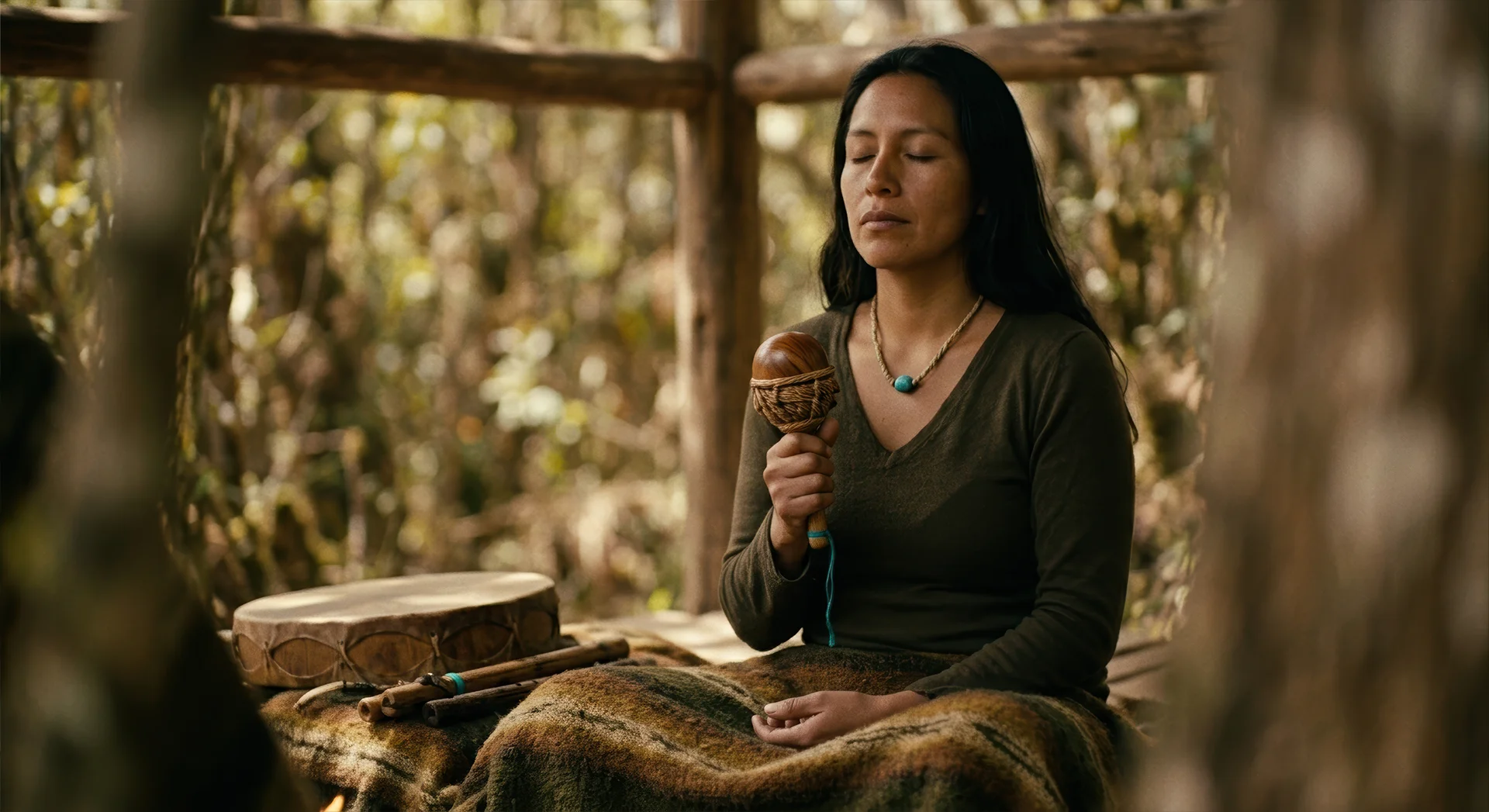
What is shamanic music?
It’s usually characterised by powerful, raw vocals, repetitive chants that can almost feel a bit otherworldly, and some simple instrumentals, such as a consistent drum beat to help induce a trance-like state.
Shamanic music is one of the clearest expressions of music that plays a functional role in healing and transformation.
Usually, we have the image of a rugged shaman in the high mountains, buried in colourful, tethered layers with a deep, throaty voice and a cowhide drum. And let’s be honest, that stereotype exists for a reason, but depending on the culture, it can sound completely different from what you might expect.
From Shipibo healers singing simple melodies taught by the plant teachers, to Yawanawá sacred songs around the fire, to Mongolian throat singing and trance-like drumming.
Shamanic music has its roots in traditional practices where sound was used to guide people into deeper states of consciousness. It wasn’t intended to be music, per se, but to provide a soundscape conducive to guiding others’ journeys.
Research published in peer-reviewed neuroscience journals has confirmed measurable changes in brainwave activity, including theta and gamma frequencies, during shamanic drumming states.
And you can still feel that power today, even through a pair of headphones. This type of music is mostly about repetition and simplicity. That means a steady drumbeat, a repetitive chant, and a melody that loops.
When something repeats, you stop jumping from thought to thought and begin to follow the sound instead. It becomes less about listening and more about being carried by it.
What is shamanic meditation music?
Over time, shamanic music has adapted and evolved to fit the many practices of the modern age.
Now, you have many different types, like shamanic meditation music or shamanic breathwork music, that serve the same role but tend to be slower, calmer, more spacious, and more ambient.
It’s easier to drop into if you’re looking for something gentle to sit with.
Shamanic breathwork music, for example, usually builds up over time. It has an arc. It takes you somewhere, then brings you back down. When it’s done well, it really takes you on quite a diverse journey through the subconscious.
A big part comes down to the instruments, and many modern forms are purely instrumental.
The drum is probably the most notable instrument used within this type of music. It resembles a steady heartbeat that continuously holds the space. Then there are often rattles, flutes, and even sounds like wind or water, often woven in to make it feel more immersive.
If you’re trying to find what works for you, don’t overthink it too much. The best shamanic drumming music or healing tracks aren’t universal. It’s personal. Some tracks will grab you, others won’t.
How to use it in your own practice
The good news is that it isn’t exclusive to ceremonies or group settings. If sung from the heart, music can have a powerful effect on consciousness wherever you are.
But that’s the thing. It’s most powerful when you participate, not just listen.
You don’t need to be a musician. You don’t need a perfect voice. You just need to be willing to open your mouth and let something out.
Humming, toning, chanting simple syllables… these are all forms of working with sound intentionally. Even singing along to a track you love, with full presence, is a form of this practice.
Here are a few simple ways you can bring it into your life:
- Sing in the morning. Take even five minutes to hum or chant. It doesn’t need to be structured. Let it be an expression of something within you. The mind should hold little influence here.
- Use it in meditation. Instead of silence, try sitting with a piece of shamanic or ceremonial music and letting it guide you inward. Give yourself permission to be moved by it, emotionally, mentally, however it happens naturally.
- Work with breathwork. Shamanic breathwork playlists are specifically designed to take you on a journey. If you do any form of breathwork at home, try building your session around music with an intentional arc, something that builds, peaks, and returns to stillness.
- Sing for someone else. One of the most profound ways to work with this is to offer a simple song or chant to another person. It could be for a person on a medicine journey, a partner, or a friend who’s going through something. You don’t need to know an ícaro. What matters is the presence you bring to it.
The more you work with sound consciously, the more you’ll feel its effect.
It becomes less of a backdrop and more of a genuine practice that can hold you through difficult states and connect you to something deeper than your everyday thinking mind.
If you’re ready to experience medicine music in its full context, held within a ceremony alongside others doing the same work, look at our upcoming medicine retreats.
We hold various transformative retreats, such as ceremonies and holotropic breathwork workshops, where you can experience the full power of this healing music.
If you’re curious about whether this kind of experience might be right for you, book a discovery call with us, and we can talk through where you are and what might serve you best.