
Currently, it’s illegal to import, possess, brew, distribute, consume, or manufacture Ayahuasca nationwide in the United States. However, as interest surges, retreat centres continue to pop up across the country.
This leads many people to wonder…
Is Ayahuasca legal in the US, and how does this affect retreat centres that operate in the country?
Ayahuasca has deep roots and a rich culture surrounding it in South America, but its status in modern legal systems such as the United States is a little more complex.
By the end of this article, you’ll have a thorough understanding of the legal status of Ayahuasca in the US, and you’ll know some of the legal protections, practical risks, and how Ayahuasca centres continue to operate there today.
This will give you a better idea of whether pursuing an Ayahuasca retreat in the US is a wise move and provide some alternatives that might suit you better.
Legal status of Ayahuasca in the US
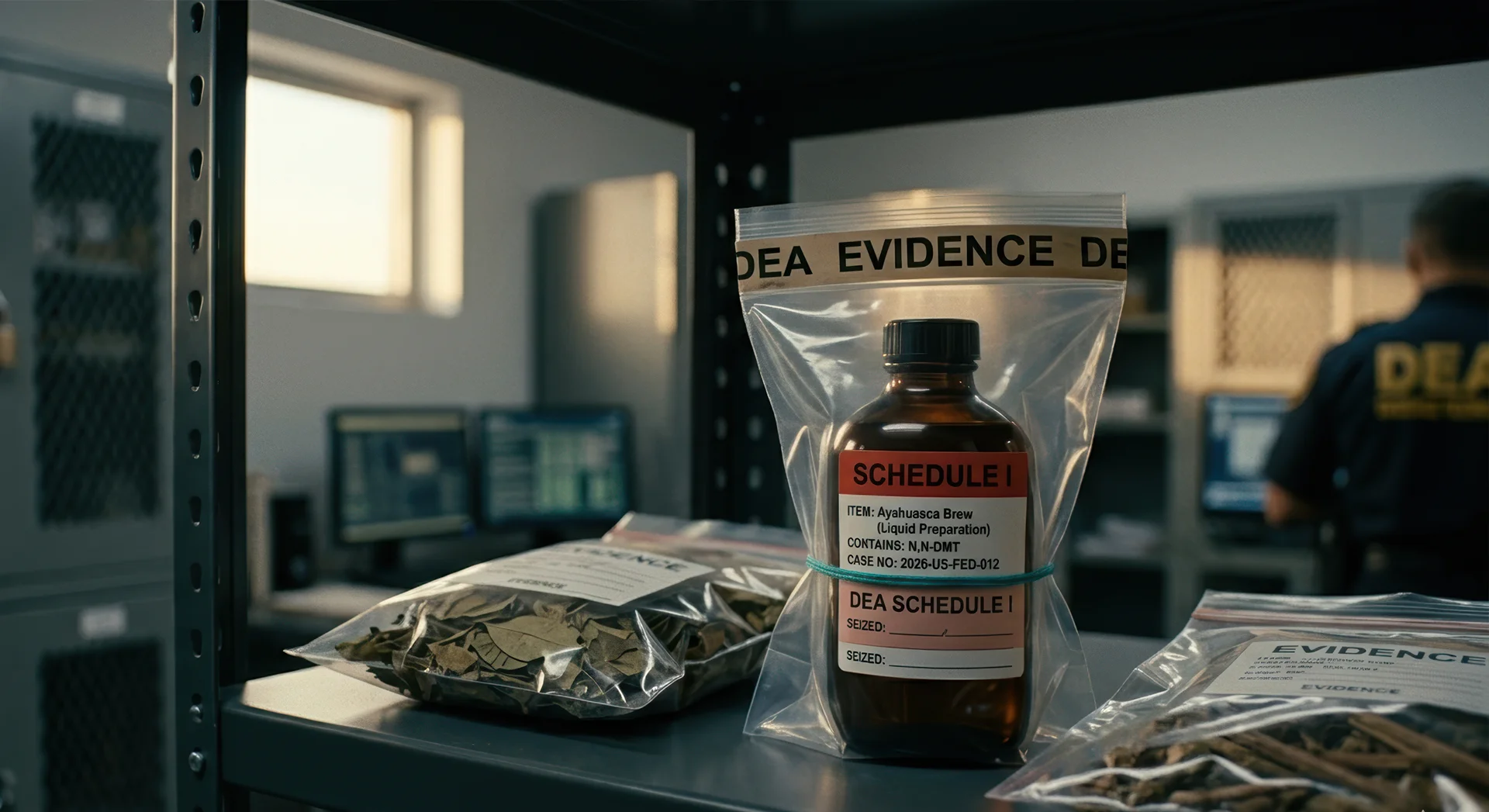
It is classified under Schedule I of the Controlled Substances Act (CSA) due to its primary psychoactive component, DMT, which the DEA deems to have no accepted medical use and a high potential for abuse.
This places it in the same category as substances like heroin and LSD.
DMT as an isolated or extracted substance (e.g., crystalline or powdered form) is prohibited in virtually every country worldwide under international conventions, though plant-based preparations like Ayahuasca receive varied treatment depending on cultural or religious context.
In the US, federal law does not distinguish the brew from pure DMT for prohibition purposes.
The statutory maximum penalty for possession with intent to distribute or the importation of substances containing DMT is 20 years in prison. Federal sentences are typically calculated based on the total weight of the seized liquid.
With that said, cases resulting in anywhere near that length of incarceration are extremely rare or nonexistent based on public records.
Although there have been numerous legal incidents related to Ayahuasca on U.S. soil to date, it is unusual for long-term prison sentences to be handed down to facilitators or users.
Instead, cases often result in plea bargains, probation, or the seizure of materials. Nevertheless, outside of explicitly exempted churches, any activity involving Ayahuasca remains a serious federal legal risk.
For a comprehensive overview of these regulations and religious exemptions, see the detailed analysis from ICEERS.
Legal grey zones in the US
Here’s the deal.
Ayahuasca is mostly illegal in the US, but there are a few narrow exceptions that create this legal grey area where a lot of retreats and ceremonies try to squeeze in.
Under a law called the Religious Freedom Restoration Act (RFRA), a couple of specific churches have actually won the right to use Ayahuasca as part of their religious ceremonies.
The big ones are União do Vegetal (UDV), which got the green light from the Supreme Court back in 2006, and Santo Daime, which won in federal court in Oregon in 2009 (and a few branches have kept those protections going).
On top of the court wins, some of these church groups have gone straight to the DEA and gotten official permission in places like Los Angeles and Washington State. However, that’s only after jumping through a ton of hoops, like strict security rules and limits on how much they can have.
But these protections are very specific.
They only cover actual members of those approved churches, not independent facilitators running retreats. It’s not like the Native American Church’s exemption for Peyote, which doesn’t carry over to Ayahuasca or other groups.
Why are Ayahuasca retreats in the US often not enforced by police?
Ayahuasca retreats in the US continue operating because federal enforcement is spotty. It tends to focus on big imports or obvious trafficking, not small private ceremonies.
In other words, the government has bigger fish to fry, and putting lots of resources into shutting down independent ceremonies simply isn’t worth the effort.
Plus, in a few progressive spots like Oakland, Seattle, Santa Cruz, or parts of Colorado, local laws have decriminalized entheogens (meaning city police usually look the other way), though federal law still technically applies.
The scene is slowly changing, though.
More churches are winning exemptions every year. But right now, the vast majority of US retreats you’re likely to find are taking a real, calculated risk. If something goes wrong, participants and facilitators could get into serious trouble.
Where is DMT legal?
DMT’s legal status changes a lot depending on where you are. Pure, extracted DMT is banned or tightly controlled in almost every country because of an old UN treaty from 1971.
Now, DMT isn’t anything new. It’s already well-established as naturally occurring in hundreds of species, with decades of evidence in plants, animals, and human bodily fluids, according to Frontiers of Neuroscience.
The legal issues come from the high concentration of DMT in Ayahuasca, which is made from Psychotria viridis (commonly known as Chacruna, which is rich in DMT), and the Banisteriopsis caapi vine (containing MAO inhibitors, which activate the DMT).
However, with cultural and ancestral roots, the use of Ayahuasca becomes much more relaxed in some places. Here’s a simple breakdown:
| Category | Countries | Legal Status | Key Details |
|---|---|---|---|
| Traditional or native use (Generally tolerated) | Peru, Brazil, Colombia, Ecuador, Bolivia | Legal or protected (Context-dependent) | Use is allowed mainly within Indigenous and traditional ceremonial contexts.
Peru, Colombia, Ecuador, and Bolivia: Protected through cultural heritage and Indigenous rights rather than strict laws. Brazil: More structured. Religions like União do Vegetal and Santo Daime are officially recognised and have regulated ceremonial use. Commercial use outside religious contexts can be restricted. |
| Grey Area (Loosely Regulated) | Costa Rica, Mexico, Spain, Portugal | Not explicitly illegal | No specific laws banning Ayahuasca, but also no clear legal protection. Retreats operate relatively openly, especially in ceremonial settings, but commercialisation is technically not permitted and can carry risk. |
| Very Strict (Illegal) | Rest of the world, including the United States | Illegal | Ayahuasca is treated as illegal due to DMT content. In the US, it’s classified as a Schedule I substance, with only a few religious groups granted special exemptions. |
A couple of other countries let related psychedelics slide (like Jamaica with Magic Mushrooms or the Netherlands with truffles), but DMT or Ayahuasca itself usually doesn’t get the same pass.
The future of plant medicines in the US
The future for plant medicines like Ayahuasca in the US looks promising, but still pretty slow-moving compared to the faster progress on things like Magic Mushrooms or MDMA.
Federal change is generally crawling; however, we have recently seen some momentum.
On 18 April 2026, President Trump signed an Executive Order titled “Accelerating Medical Treatments for Serious Mental Illness”, directing the FDA and DEA to fast-track the review and approval of psychedelic drugs as therapeutic treatments, with particular focus on psilocybin and ibogaine.
The order allocates $50 million in federal funding for research, instructs the FDA to issue Priority Review Vouchers to psychedelics that have already received Breakthrough Therapy designations, and establishes a pathway for eligible patients to access investigational psychedelic drugs under the existing Right to Try Act.
Most importantly, the order does not legalise any substance. Psilocybin, Ibogaine, DMT and Ayahuasca remain Schedule I controlled substances under federal law… But it does represent the most significant shift in US federal psychedelics policy in decades, which signals a clear directional change that is already accelerating investment, clinical trials and regulatory momentum across the sector.
With that said, the psychedelic reform scene is also heating up through state-level action.
Oregon and Colorado already have regulated psilocybin therapy programs (with Colorado potentially expanding to include DMT, ibogaine, and mescaline after mid-2026).
New Mexico is rolling out psilocybin therapy by late 2026, and dozens of other states have bills or task forces active this year looking at regulated access for various psychedelics.
The DEA is even bumping up research quotas for DMT and other psychedelics in 2026 to support studies on things like PTSD and depression, showing at least some openness at the federal level for science.
Will Ayahuasca ever be legal in the US?
Most bills focus on Magic Mushrooms first, but there’s real spillover.
Colorado’s natural psychedelics decrim includes DMT, and a few more churches are winning narrow RFRA exemptions (like Church of Gaia in 2025), which could slowly expand protected religious use.
Public support is growing too (though still low compared to cannabis back in the day), and groups like MAPS are pushing policy guides for everything from decrim to equitable access.
Overall, Ayahuasca is following a cannabis-like path to legality.
Patchy state-by-state wins create a messy but expanding map of access, reduced local enforcement in progressive spots, and more research driving the conversation.
Federal barriers are big, but if psilocybin or MDMA get FDA nods of approval, it could open doors wider for Ayahuasca down the line (maybe by the 2030s).
If you’re excited about plant medicines but want to avoid the US legal headaches right now, have a look at our upcoming Ayahuasca retreats in Spain for traditional Indigenous ceremonies with modern practices of preparation, integration, and personalised care, or book a call with our team to ask your questions and connect before taking the next step.